Professional development for traffic safety auditors and inspectors
Safety is not assumed.
Safety is designed, built, and adapted to the times we live in.
Traffic safety auditing represents the last opportunity to re-examine and adapt solutions conditioned by design or history to modern conditions, before potential flaws turn into human tragedy.
To professionally develop traffic safety auditors and inspectors, Unipromet recently contributed by sharing practical knowledge and experiences through two sessions of training.
📍 December 11 – Čačak
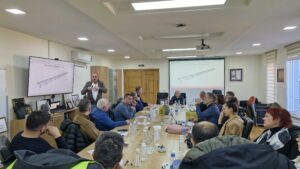
The training was held at Unipromet’s facilities. In addition to expert lectures, participants toured the production plants, where the complete product creation process was presented—from raw material intake to the final product for road safety. The visit concluded with informal networking and experience sharing.
📍 December 12 – Novi Sad
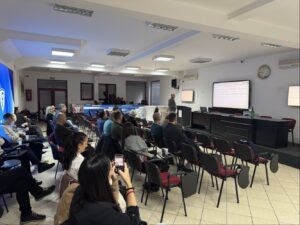 On the second day, the training was successfully conducted at the TSRD center, in the premises of the Faculty of Economics and Engineering Management.
Representing Unipromet, engineers Darko Jelić and Jovan Bojović shared their knowledge and extensive practical experiences with participants, through real-world examples and analysis of actual road situations.
This training format went beyond processing theoretical knowledge, focusing also on understanding real traffic scenarios—those where design oversights, system failures, inadequate retention levels, or poor installation can have serious, even fatal, consequences for road users.
The training covered:
- The SRPS EN 1317 standards series, testing of systems and their practical application (testing, evaluation, CE marking, CPR, FPC);
- The fact that today’s traffic structure significantly deviates from that of 20–25 years ago—greater vehicle mass and higher center of gravity require a different approach to safety;
- Real examples of traffic accidents showing that former design solutions, though formally correct, are often inadequate today;
- Differences between testing conditions and real operational conditions for vehicle restraint systems (inadequate ground preparation, insufficiently driven piles, unprofessional installation) and their impact on the system’s expected performance in real traffic.